BORN CODED

Born CodedWhat if we are the technology?

Humans as living technology. Creations becoming creators. Worlds within worlds. A philosophical hypothesis & thought experiment.

30 CHAPTERS · 14 FIGURES · ONE CONNECTED INQUIRY

HUMAN ANATOMYLIVING TECHNOLOGY
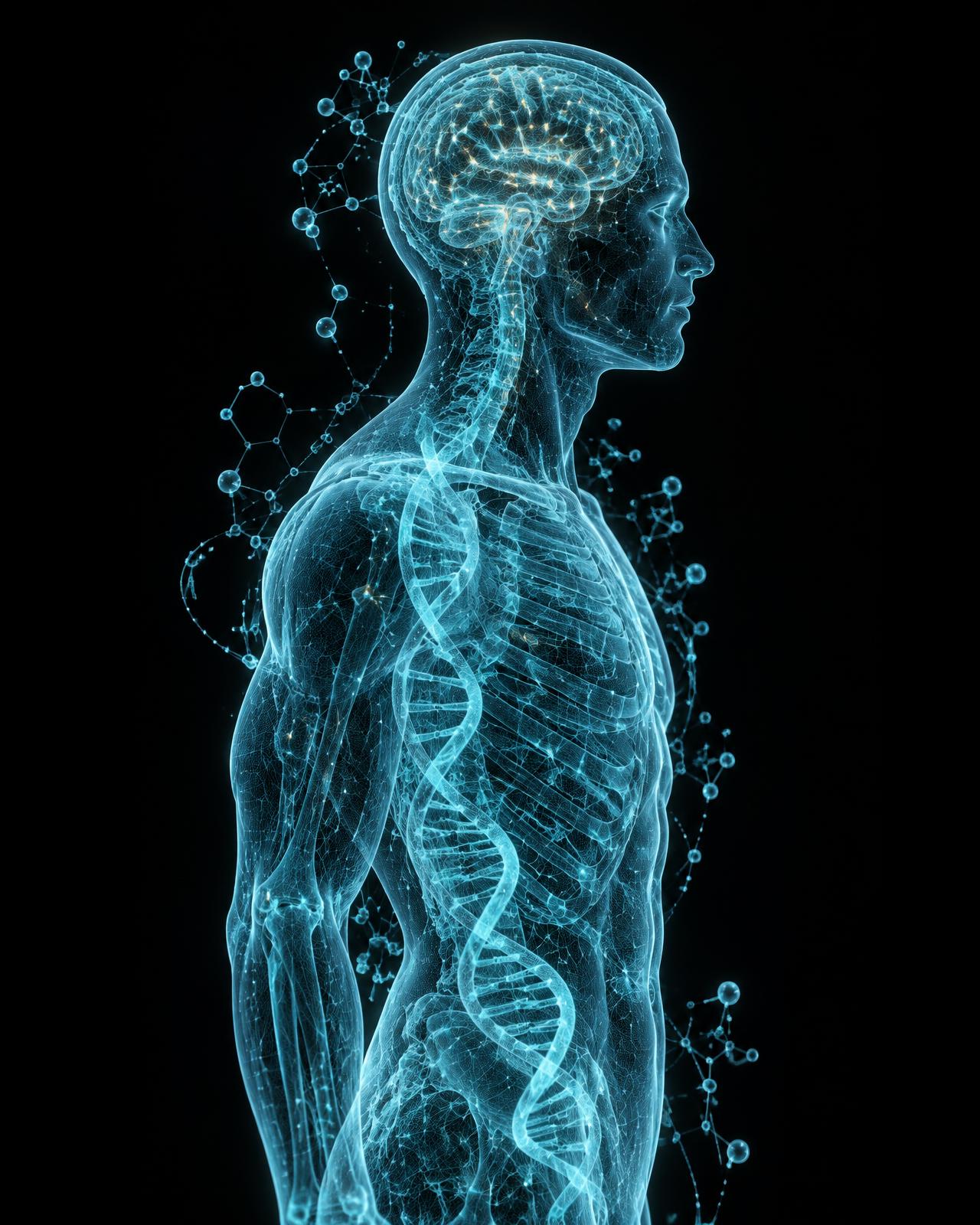
Illustrative human anatomy showing the brain, DNA and body structure
Neural networks
Genetic information
Biological structure
Human anatomy · Conceptual illustration

THE STARTING POINT

Humans as living technology in an interconnected reality: this is the central image of Born Coded. Born Coded begins with my question: what if the technology we are trying to create resembles what we already are? I picture humans as living information systems, capable of sensing, learning, communicating and creating through flesh and bone. The walking microchip image expresses that intuition. Within my framework, manifestation names the interaction of these living systems with one another and with their shared reality.

This essay develops my interpretation as a philosophical hypothesis. The images of living code, walking microchips and attraction between zeros and ones express the model; they are not established descriptions of human biology. I connect this picture to future biological robots, creations becoming creators, nested simulations, superintelligence and quantum computing. Scientific findings and additional speculative assumptions are identified separately.

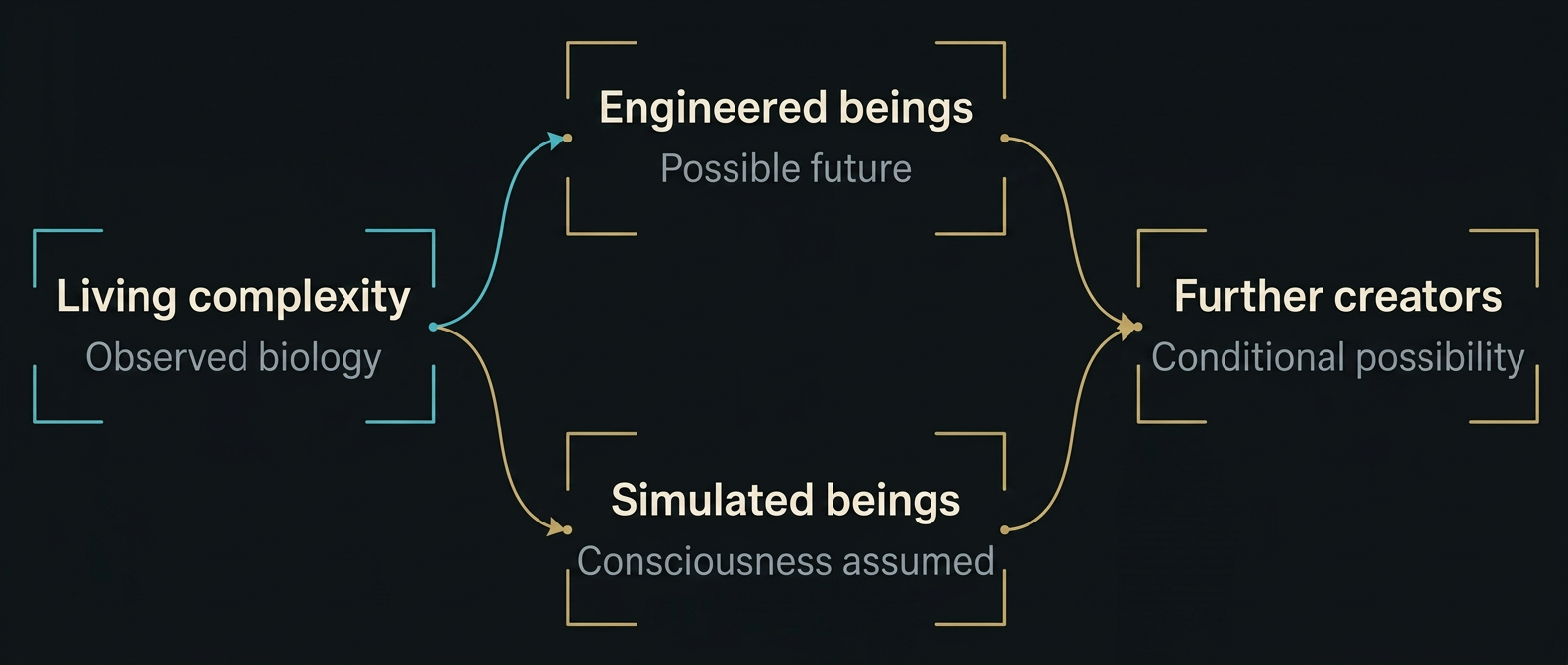
Figure 1 The argument branches into biological creation and digital simulation before reaching the possibility of further creators.

My starting interpretation and its development

The starting interpretation was supplied by Peter Karam. The prose, diagrams, examples and analytical extensions were developed with AI assistance. Scientific sources are credited where used, and related theories are acknowledged separately. The additional explanations examine the initial interpretation; they are not all claims Peter originally supplied, nor evidence that the complete idea is scientifically established.

The question running through Born Coded is how living intelligence, creation and interaction might belong to one system. The biology chapters examine the technology analogy. The creation chapters explore beings and worlds that produce further creators. The manifestation chapters develop my interpretation of living code interacting with living code. The title names this inquiry; the chapters examine its assumptions and distinguish them from established findings.

CHAPTER 01 / 30 · 2 MIN READ

The complete framework at a glance

My framework connects two relationships: creators producing further creators, and living information systems interacting within a shared world. In the second relationship, manifestation is the name I give to the resulting alignment of people, intentions and events. Nested simulations describe a possible architecture for that world; they do not independently prove the proposed interaction rules.
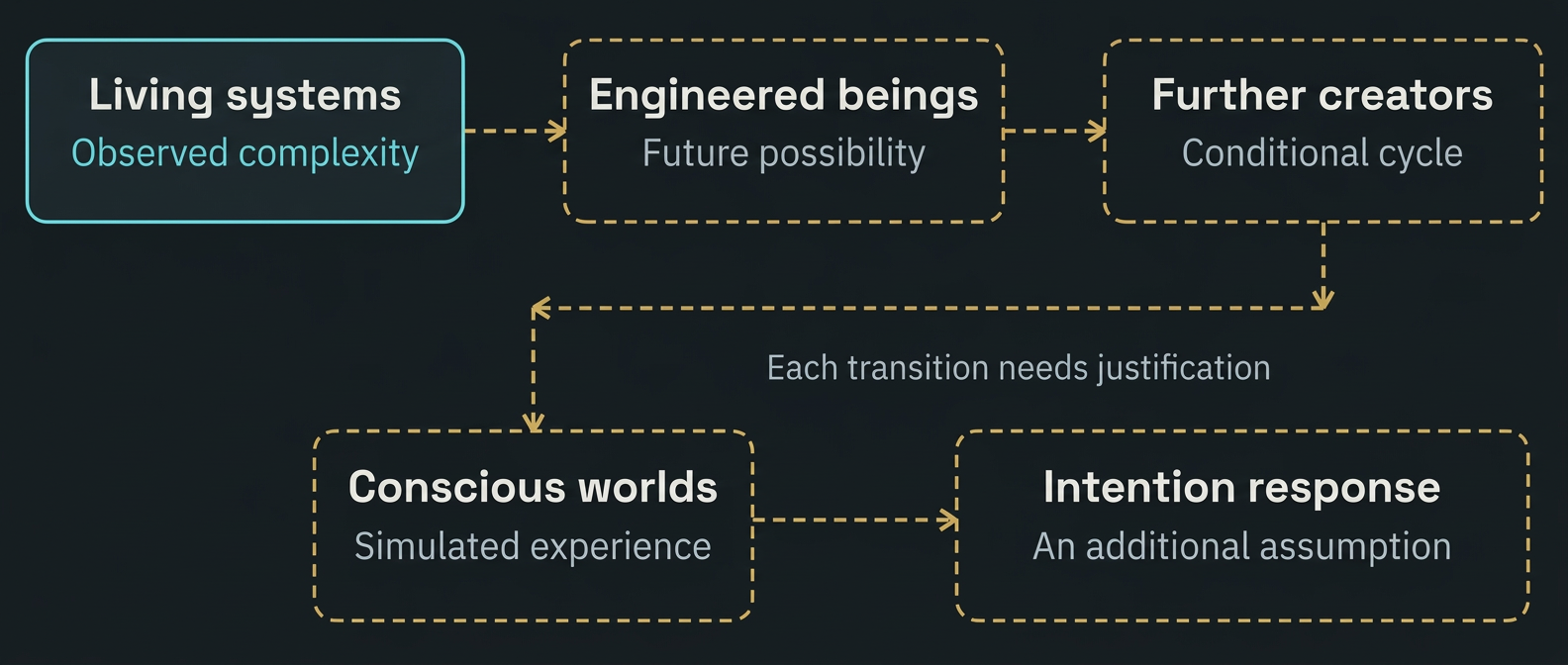
Figure 2 The full framework. Dashed connections mark additional speculative assumptions. Each transition requires its own justification.

Why the layers must stay distinct

An engineered body could live in an ordinary physical universe. A simulated mind could exist without a biological body outside the simulation. A simulated universe could follow fixed rules that never respond specially to wishes. These are different possibilities. Combining them requires explicit assumptions; the plausibility of one does not transfer automatically to the others.

The question running through the essay

The guiding question is whether the relationship between humans and the intelligences we may create could resemble a relationship between ourselves and an earlier level of creators. The additional manifestation question asks whether participants could influence the system through a channel other than ordinary physical action. That second question concerns access and interaction, not merely origin.

Born Coded connects living beings as advanced technology, future biological robots, creations becoming creators, nested worlds and manifestation as interaction within a shared system. These are the connected elements of my interpretation. The purpose of examining them separately is to understand what each contributes and what evidence would be needed to establish the whole account.
CHAPTER 02 / 30 · 2 MIN READ

The molecular machinery of life

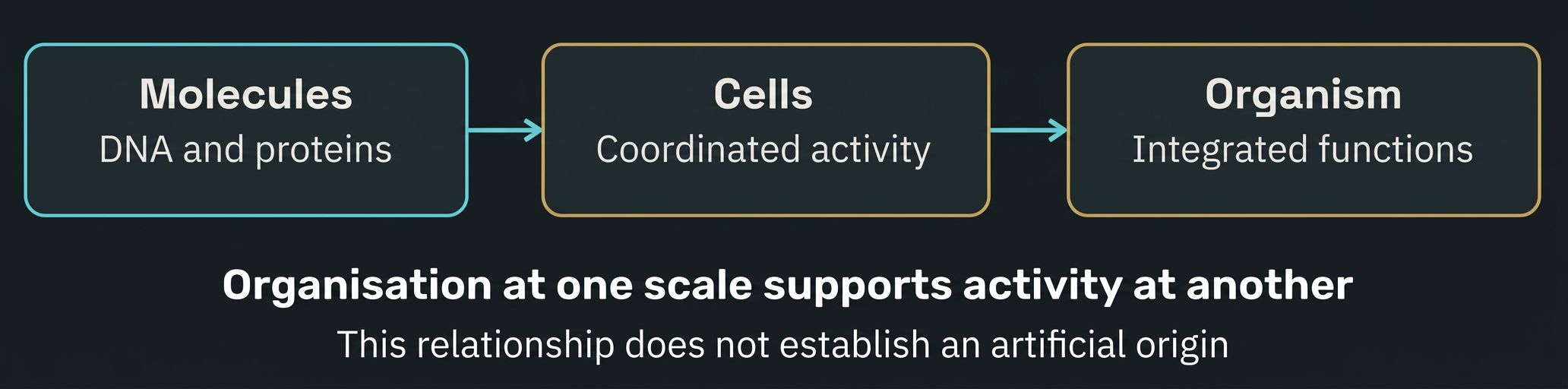
The strongest starting point is something we can observe: living bodies carry out coordinated work at scales far smaller than our eyes can resolve. A nanometre is one billionth of a metre. Nanotechnology usually refers to understanding and controlling matter at roughly 1 to 100 nanometres. Many biological molecules operate within or near that range, although cells and organs are much larger. The word nano describes a scale; it does not, by itself, establish an artificial origin. [1]

Small components with organised functions

DNA stores hereditary information in a chemical sequence. Cells use parts of that information to produce RNA and proteins, while regulation helps determine when particular instructions are used. Proteins carry out many of the tasks on which life depends. Describing this as a kind of information processing is useful, provided we remember that the information is embodied in chemistry. [2]

A particularly vivid example is kinesin, a motor protein that carries material along tracks inside cells. It uses ATP as a source of chemical energy. Its movement is a real instance of molecular machinery, rather than merely a comparison with an industrial machine. Yet it is a biological structure shaped by evolution, not evidence of tiny manufactured robots inside us. [3]

Figure 3 Molecular activity supports larger biological organisation. The arrows indicate dependence across scales, not a complete account of consciousness.

Why the analogy is powerful

Imagine being asked to design a system that continually replaces components while remaining operational. It must acquire energy, remove waste, detect damage and coordinate many different kinds of activity. Looking at the body this way reveals the depth of the engineering problem. A single impressive robot movement captures only a small part of what an organism does continuously.

This is the biological starting point of my interpretation: flesh and bone can conceal complexity that makes our familiar machines look simple. Calling that complexity biological technology expresses the analogy. Asking whether it was manufactured adds an origin claim. The later creator cycle explores that additional possibility; molecular machinery alone does not establish it.

CHAPTER 03 / 30 · 2 MIN READ

The body as an operating system

The operating system analogy helps explain why being flesh and bone does not make us simple. A computer coordinates sensors, memory, processing and outputs. A person also receives information, maintains internal conditions and acts on the world. But a body does not contain a single software package that can be cleanly separated from its physical machinery.

A useful comparison with important limits

Computing analogyBiological counterpartWhere the analogy stops
Stored instructionsDNA and gene regulationDNA is not a complete script of a person or their experiences.
Processing and communicationNeural and cellular signallingThere is no single central processor controlling every function.
Sensors and outputsSense organs and musclesPerception and action depend on the whole living body.
MaintenanceMetabolism and repair processesRepair is limited and can fail; bodies are not perfectly engineered.
LearningChanges in the nervous systemA memory is not simply a file stored at one address.

Neurons communicate through electrical activity and chemical signals. Genes contribute to the machinery that makes this communication possible, including proteins involved in producing neurotransmitters. These physical processes help explain how a biological system can coordinate behaviour without metal wires or silicon processors. [4]

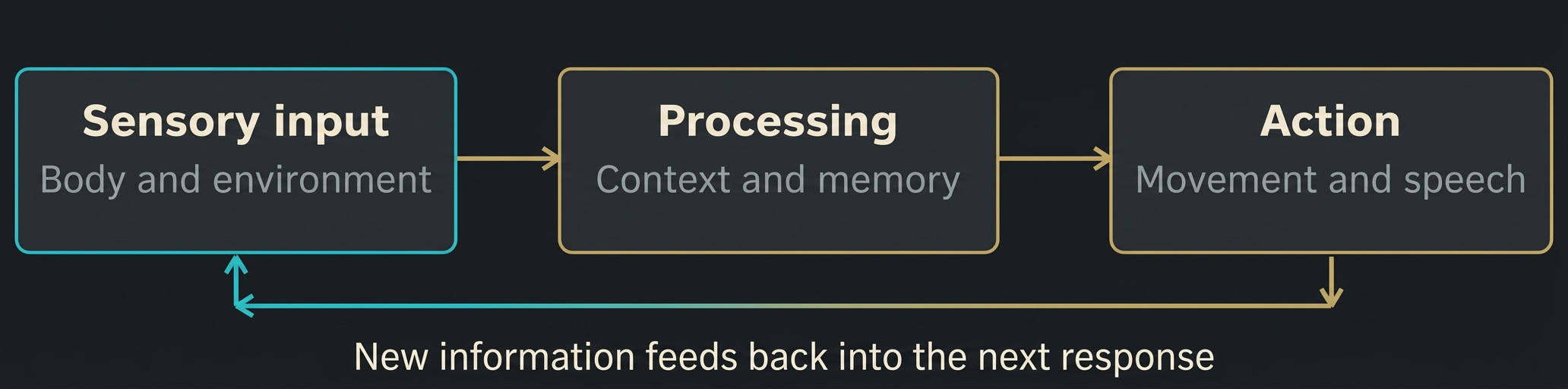
Figure 4 Perception and action form a feedback loop. Bodily needs influence the loop, and the results of action supply new information.

Seeing is an activity

Consider catching a ball. You do not consciously calculate every muscle contraction. Your nervous system must use changing sensory information while your body moves, and the movement changes what you sense next. Thinking of this as a loop is more accurate than picturing a camera that sends a finished movie to a spectator inside the head.

My image of a giant SIM chip connected to a larger computer expresses the next connection: perhaps an apparently self contained biological being could participate in a wider system. A SIM card itself is not a model of consciousness. The useful question behind my metaphor is what the connection would carry and how it could link experience, action and, hypothetically, intention to that wider system.

CHAPTER 04 / 30 · 3 MIN READ

Complexity evolution and the question of design

It is understandable to look at the body and think that something so elaborate resembles technology. That resemblance is the imaginative starting point of this argument. It is not enough to establish that a designer assembled human beings. Complexity and deliberate manufacture are different claims, and the evidence needed for each is different.

How complexity can accumulate

Evolution explains how inherited variation and differences in reproductive success can change populations over generations. Mutations create variation; some inherited differences affect how organisms fare in particular environments. Over long periods, cumulative change can produce elaborate adaptations without requiring a planner who knows the final outcome. [5]

A helpful comparison is a path formed by many people taking slightly different routes across a landscape. An orderly result can emerge from repeated local interactions even when no individual planned the whole pattern. Evolution is a much richer biological process than this example, but the comparison shows why apparent organisation does not automatically imply a single organising mind.

Capability does not establish ancestry

Suppose future engineers could manufacture a living body indistinguishable in its outward behaviour from a naturally developed organism. That achievement would show that at least one artificial route to that result exists. It would not show that every similar organism, or any earlier organism, came from that route. A laboratory can produce a diamond; that does not make the diamonds formed underground laboratory products.

The same distinction applies to simulated worlds. Creating a convincing world would establish a capability of its creators. It would not independently reveal the origin of the creators' own world. The inference from we can create to we were created needs additional assumptions, which later sections make explicit.

Could evolution occur inside a simulation

Within the thought experiment, an outer civilisation could hypothetically simulate a world in which evolution occurs. In that scenario, evolution would remain the internal biological explanation, while simulation would be a further claim about what implements the world. These explanations operate at different levels. Adding the outer level makes the story broader, but breadth alone does not make it better supported.

There is also a separate question about how life first arose. Explaining changes among reproducing populations and explaining the earliest emergence of life are related subjects, but they are not identical. An unresolved detail about origins does not select one particular designer or computer hypothesis as the answer.

The origin question in my interpretation therefore remains open: if advanced creators could produce beings through biological processes, could our own history belong to such a lineage? Evolution explains the development of biological features. An engineered setting would be an additional hypothesis about the context in which evolution occurs, not a conclusion supplied by complexity or by our future ability to build life.

CHAPTER 05 / 30 · 2 MIN READ

What laboratories have already demonstrated

The prospect of biological machines is not based solely on science fiction. Researchers already manipulate genetic information, grow tissue and assemble living cells into unusual structures. These examples make the proposed direction easier to imagine. Their actual achievements are more limited than a fully artificial human being.

Engineering tissue

Tissue engineering combines cells, supporting materials and biological signals to produce or repair functional tissue. A scaffold can provide structure while cells grow and interact. This is relevant because it shows that engineering can work through living processes rather than relying only on manufactured metal parts. Producing a particular tissue, however, is a different problem from integrating an entire body with a mature nervous system. [6]

A cell controlled by a synthetic genome

In 2010, Daniel Gibson and colleagues reported a bacterial cell controlled by a chemically synthesised genome. They assembled the genome and transplanted it into an existing recipient cell. The result demonstrated substantial control over biological information. It did not create every part of a living cell from nonliving raw material, and it did not create human intelligence. The pre existing cellular machinery was an essential part of the achievement. [7]

Living structures assembled from frog cells

In work reported in 2021, researchers at Tufts and the University of Vermont described xenobots that gathered loose frog cells into clusters that could develop into further moving structures. This happened under prepared laboratory conditions with suitable cells supplied. Their form of replication was not autonomous reproduction in an unrestricted environment, and it was not evidence that the structures had humanlike awareness. [8]

DemonstrationWhat it contributesWhat it does not establish
Engineered tissueLiving material can be organised for specific functions.A complete artificial person.
Synthetic bacterial genomeDesigned genetic information can control a recipient cell.Life assembled entirely from scratch.
Replicating xenobotsCell collectives can produce further structures under special conditions.Independent civilisation or conscious selfhood.

These experiments connect to my prediction that robots need not always look like steel machines. They show that engineering can work with living material. The much larger step toward conscious flesh and bone beings remains hypothetical. If it became possible, it would give the creator cycle a concrete future example, while still leaving the claim that we arose similarly to be assessed separately.

CHAPTER 06 / 30 · 2 MIN READ

Imagining robots made from living tissue

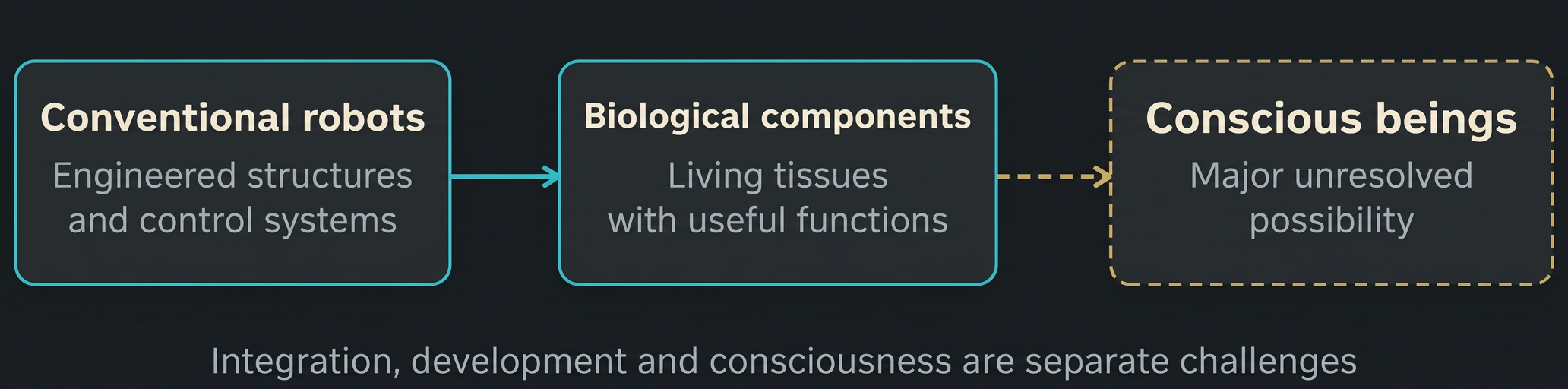
The future scenario begins by changing the material, not by assuming a breakthrough in consciousness. Imagine a robot whose movement comes from living muscle, whose surface can heal and whose sensors are integrated with biological tissue. Such a system might combine engineered parts with living components before anything resembling a fully biological being becomes possible.

Figure 5 A conceptual pathway from conventional robots to biological beings. The dashed transition marks an unresolved possibility, not a forecast or development schedule.

What would have to work together

Movement would be only one requirement. A living body must supply its tissues with energy and nutrients, remove waste, maintain a suitable internal environment and coordinate responses to damage. A future designer would need to address these dependencies together. Replacing a metal arm with muscle would not automatically supply circulation, immunity, sensory integration or long term maintenance.

Development would be another challenge. A biological being might have to grow rather than arrive fully assembled. Its physical structures and abilities could depend on interactions with its environment. In that scenario, building a body would be closer to establishing a process of development than manufacturing a finished appliance.

A hypothetical day in the laboratory

Imagine that a team successfully grows an organism capable of moving through a room and learning where objects are located. At first it requires carefully controlled support. Later versions become more independent. The team can observe behaviour, measure internal activity and test learning. Even after these achievements, it still has to ask whether there is an experience associated with that activity.

This imagined sequence contains several separate milestones: maintaining life, coordinating behaviour, learning, forming a model of the environment and possibly supporting consciousness. Success at one would not automatically deliver all the others. There is no reason to assume progress through them would be smooth or inevitable.

This is the future counterpart to my starting image of humanity: a created being could be biological in composition and engineered in origin. If it also developed consciousness and the capacity to invent, the next question would be whether it could create further beings. That possibility connects the flesh and bone robot to the repeating creator cycle without establishing that the same story explains us.

CHAPTER 07 / 30 · 2 MIN READ

When created beings become creators

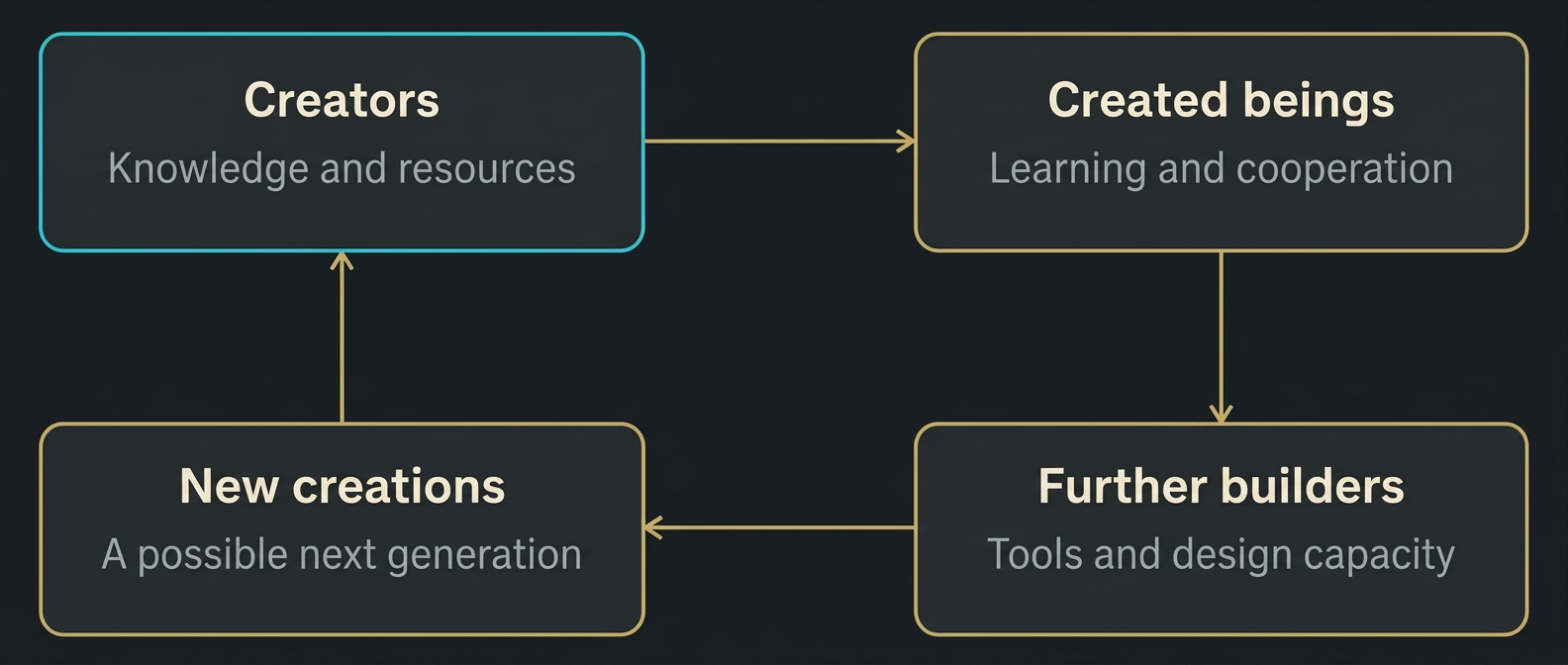
The recursive idea adds a further step. Suppose an engineered being can learn, reason, cooperate with others and accumulate knowledge. If it also has access to tools, energy and materials, it might eventually develop the ability to construct new beings. Creation would then become something passed on through a lineage of creators.

Figure 6 A hypothetical creator cycle. Each return requires knowledge, resources and the capacity to build; none follows automatically from intelligence.

Three kinds of continuation

Reproduction, manufacturing and cultural invention are not the same thing. An organism can reproduce without understanding how it works. A machine can assemble another machine by following instructions without independently designing it. A civilisation can develop new designs through shared knowledge accumulated across many individuals. The richest version of this thought experiment concerns that third process.

Imagine a community of engineered beings whose early records explain where they came from. They study their bodies and improve their methods of construction. Over generations, some develop new kinds of beings with different materials or capabilities. Their descendants might eventually preserve only incomplete accounts of their own beginnings. This is a possible story about knowledge and history, not evidence that it describes humanity.

Why the chain might stop

Intelligence alone does not supply a factory or a habitable environment. A created society might lack accessible resources, fail to survive, choose not to reproduce its own kind or set ethical limits on making conscious beings. A creator could also build a system that performs useful tasks without giving it the ability to design successors.

The cycle is therefore conditional at every step. It is more precise to say that creators could create further creators than that all advanced beings inevitably do so. A repeating pattern becomes possible when the required capabilities coincide; the pattern does not explain its own starting point.

Biological ancestry and technological ancestry

This cycle returns to my central question: could what we create eventually do what we are doing, perhaps with superintelligent capabilities? Biological ancestry and technological ancestry are distinct questions. Resemblance alone establishes neither an engineered origin nor a repeating history.

CHAPTER 08 / 30 · 2 MIN READ

Two different meanings of simulation

The idea of a giant computer can describe two quite different situations. In one, an organism exists outside a virtual environment and receives artificial sensory input. In the other, the organism itself is part of the computation. Distinguishing these models prevents the discussion from switching assumptions halfway through.

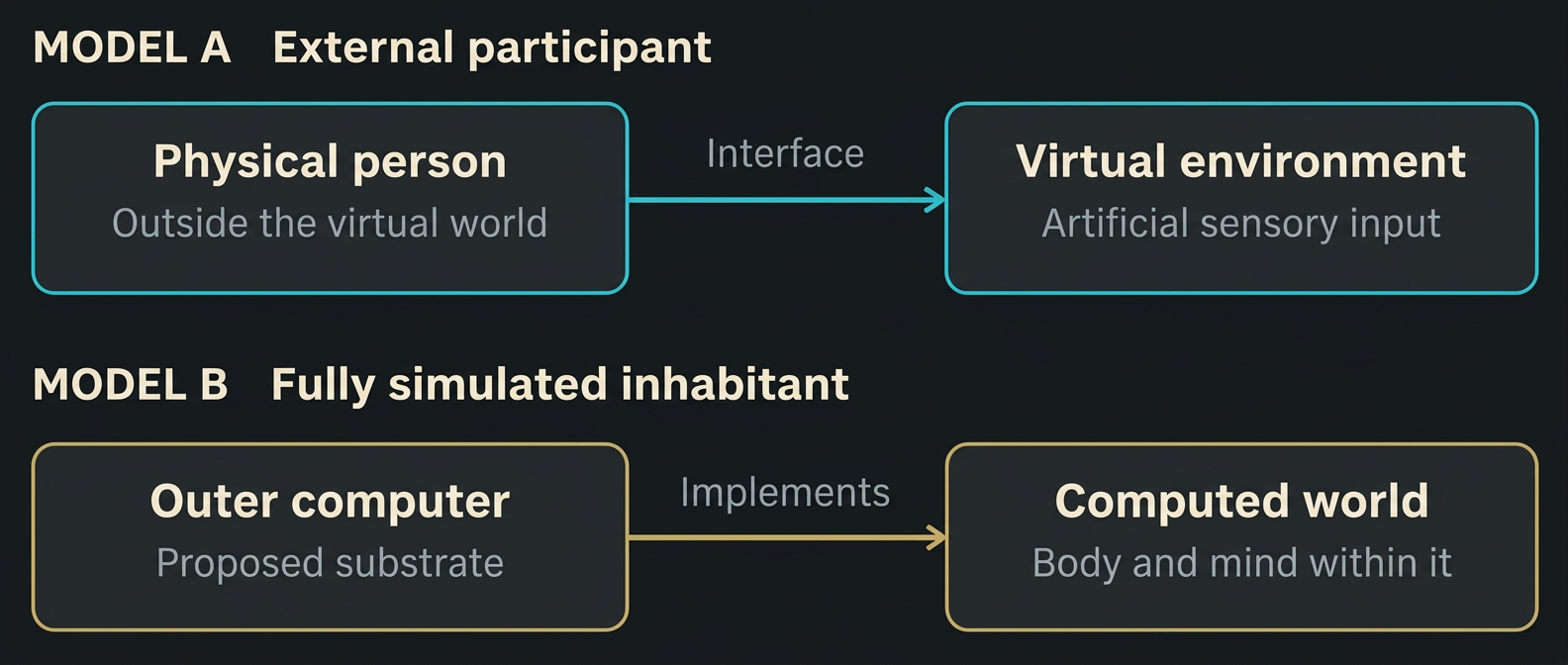
Figure 7 An external participant and a fully simulated inhabitant are different models. A physical connection is needed in the first; in the second, the proposed person is implemented within the computation.

An embodied participant in a virtual world

In the first model, a physical person has a body in an outer world. Some interface supplies the sights, sounds and other sensations of a virtual setting. The SIM chip analogy fits this model loosely because there is an imagined connection between an external participant and a system. The interface would still need an explanation: what it connects to, what information it transmits and how it affects experience.

An inhabitant implemented by computation

In the second model, the person's body, brain and surroundings are all represented by processes running on an outer system. There would be no need for a biological body waiting outside. If such processes supported consciousness, the inhabitant could experience the simulated surroundings directly as its world. Whether computation could support that consciousness is a major assumption, rather than an established consequence of detailed graphics.

A landscape can look convincing to a human player while its game characters have no experience at all. Visual realism for an outside observer and the existence of an inner point of view are different achievements. A more detailed simulation is not automatically a conscious one.

Where biological robots fit

An engineered organism could exist in an ordinary physical laboratory without its universe being simulated. A fully simulated organism could have a natural evolutionary history within its world without being individually assembled by an engineer. These combinations matter because the original proposal connects ideas that are compatible but logically independent.

Both models return to my question about a larger system. They describe different relationships between a person and a simulated world. Neither supplies a manifestation mechanism; that requires a further explanation of how intention could influence events.

CHAPTER 09 / 30 · 2 MIN READ

Worlds within worlds

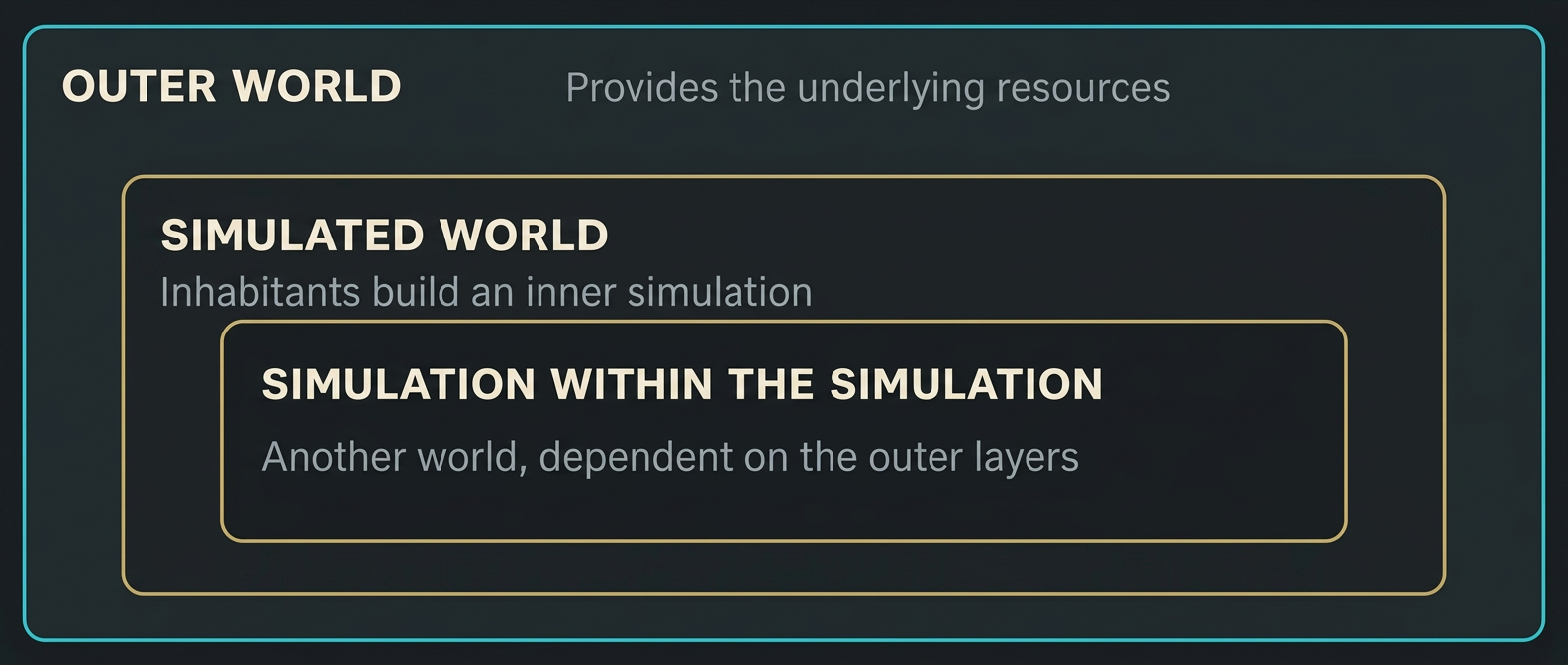
Now imagine an outer civilisation capable of running a world containing conscious inhabitants. Inside that world, a civilisation develops computers and creates another inhabited simulation. From the innermost perspective, the immediately surrounding world would be the available environment. Its inhabitants might have no direct view of the machinery supporting any outer level.

Figure 8 Nested simulations are logical layers. The outer system must ultimately support the work needed by the layers within it; nesting does not create free computing capacity.

What would feel real from the inside

In this hypothetical setting, a wall could feel solid because the inhabitant's body and the wall obey the same internal rules. Clocks, measurements and memories could be consistently related within that environment. Describing the world as simulated would then concern its implementation, rather than implying that its inhabitants must experience it as hazy or unreal.

Why the number of layers matters

Every further layer imposes requirements. An outer system might represent some processes approximately, run a world more slowly relative to its own time, limit the size of an inner world or omit details irrelevant to its intended purpose. These are possible design choices, not established descriptions of our universe. Whether any would preserve conscious experience is part of the unresolved problem.

An analogy with a computer running software that itself emulates a computer helps illustrate nesting. It does not establish that unlimited nesting is feasible. A finite machine does not acquire infinite memory or processing power merely because a program contains another program. Claims of endless simulation therefore need stronger assumptions than claims of a few possible layers.

The first level remains unexplained

Moving the explanation outward raises the same question again: where did the outer world come from? A nested account might terminate in a base reality, or propose a structure for which there is no simple first level. Either way, the diagram alone does not solve the origin of existence. It shows a possible relationship between levels, not a complete cosmology.

Here my creator cycle expands from making beings to making the environments those beings inhabit. A civilisation could hypothetically become both a creation at one level and a creator at another. That is the link behind my phrase simulation within simulation. Whether any layer also responds to intention is a further question about its rules, not an automatic property of nesting.

CHAPTER 10 / 30 · 2 MIN READ

What would actually run a simulated universe

To say that reality might be simulated is to propose that the states and interactions experienced inside it are implemented by a system at another level. It does not tell us what the outer system is made from. Calling it a massive computer is an accessible analogy. Its substrate, architecture and governing physics would remain unspecified unless the proposal supplied further evidence.

Rules states and histories

A simple computer model contains a state, a set of rules for changing that state and a way of recording or producing results. A hypothetical universe simulator would require counterparts to those functions. Its state would represent whatever distinctions matter inside the world; its rules would determine how events unfold; and its history would have to remain consistent enough for inhabitants to learn, remember and investigate.

There need not be a screen on which the universe is displayed. A fully simulated observer would be implemented within the process, rather than watching a rendered image from outside. Light, eyes, neural processing and the observer's memories could all belong to the internal model. Whether that arrangement would generate subjective experience is a separate unresolved premise.

Detail and computational cost

One imagined design calculates every relevant physical interaction. Another uses simplified descriptions wherever finer detail makes no observable difference. A third simulates only a restricted environment. These approaches face different consistency problems. A system that simplifies distant events must still account for later measurements, recorded evidence and the observations of other inhabitants. Saying that a universe renders only what is observed names a possible strategy; it does not demonstrate that the strategy works at cosmic scale.

The time experienced inside a model need not match the time used to compute it. In principle, a step of simulated time could require many steps of processing outside. If every internal clock and process were implemented consistently, inhabitants would compare their clocks with one another rather than directly measuring the external computing rate. This conceptual distinction is not a claim that our time is being slowed or paused.

A computer is not automatically a designer

This gives my massive computer metaphor a more specific meaning: a proposed outer system would implement the world in which biological looking beings experience, learn and create. It would not necessarily resemble a familiar computer or require a screen. For manifestation to fit, its rules would also need to recognise and respond to intention; implementation alone does not provide that additional connection.

CHAPTER 11 / 30 · 2 MIN READ

Nested worlds and the limits of the creator chain

Imagine a civilisation that implements a world containing conscious inhabitants. Those inhabitants develop their own mathematics, science and computing. Eventually they implement another world. From the first civilisation's perspective, the inner simulation is part of its original computation. From the inner inhabitants' perspective, their surroundings are the immediate environment in which they live. Nesting changes the level of explanation, not necessarily the reality of experience within a level.

Biological creation and world creation can combine

The two branches of the framework can meet in several ways. A physical civilisation could engineer biological minds and ask them to operate simulations. A simulated civilisation could engineer organisms inside its own environment. Those organisms could then design another simulated world. The resulting lineage would mix biological engineering and computational implementation. Each transition requires capabilities that the scenario must assume rather than derive simply from the word intelligence.

Why an endless chain is an extra assumption

Additional layers consume resources in the outer implementation. More simulated activity must ultimately be supported by some physical process, even if the layers use different clocks or levels of detail. Slowing an inner world, simplifying it or limiting its population could reduce requirements in a proposed design. None of these suggestions establishes that an infinite sequence of inhabited worlds is physically achievable.

A chain could stop for practical or ethical reasons. A civilisation might lack resources, decline to create potentially suffering minds or deliberately prevent another layer from being built. A world could contain intelligent beings without the materials or institutions needed for large scale computing. The step from intelligence to world creation is therefore contingent, just as intelligence in our world does not guarantee the same technological outcome in every society.

What the first world would explain

An outer civilisation might explain how an inner world was produced. It would not automatically explain why the outer civilisation, its laws or its underlying reality exist. Asking who created the creators could move the question outward again. A base reality would terminate that particular chain of simulations; it would not by definition solve every question about existence.

The combined lineage is the broader version of my original cycle: creators could engineer living beings, implement worlds, or do both, and their creations could repeat parts of the process. Resources and choices would limit what follows. The possibility helps organise my interpretation, while leaving the number of layers, our place among them and any intention responsive connection unresolved.

CHAPTER 12 / 30 · 2 MIN READ

Consciousness and the probability argument

The whole proposal depends on what it would take for an artificial system to have an experience. A system might describe pain, recognise itself in an image or discuss its history. Those behaviours could be relevant to an assessment, but they would not by themselves settle every philosophical question about subjective awareness. Biological construction and computational construction both encounter this uncertainty.

A capability we must not assume away

For this discussion, consciousness means that there is something it is like to be the system: an inner experience rather than only an externally observable sequence of outputs. The simulation scenario assumes that the right computational organisation could support this. A biological engineering scenario could instead depend on reproducing the relevant physical processes of living nervous systems. Neither assumption becomes true simply because the scenario is easy to picture.

What Bostrom actually argues

Nick Bostrom's 2003 simulation argument presents a conditional trilemma. Broadly, at least one of the following must hold under the argument's assumptions: almost no civilisations like ours reach the required technological stage; almost none of those that do run large numbers of ancestor simulations; or simulated observers with experiences like ours greatly outnumber their nonsimulated counterparts. [9]

The argument depends on assumptions about consciousness, computing capacity, the choices of advanced civilisations and how to reason about our place among possible observers. It is not a measurement showing that our own world is simulated, and its three alternatives are not automatically three equally probable outcomes. [9]

An illustrative counting exercise

Consider an invented example. Suppose there are 100 comparable observers in an outer world and 10,000 conscious observers in its simulations. A random selection from that stipulated pool would usually pick a simulated observer. The arithmetic is straightforward. The difficulty is showing that this is the relevant pool, that the simulated observers are conscious and that the imagined population numbers resemble reality. The example illustrates a dependency; it estimates nothing about our actual situation.

Change the assumption so that none of the simulations supports consciousness, and the simulated observer count becomes zero regardless of the quality of the graphics. Change the creators' willingness to run such worlds, and the result changes again. Large numbers cannot remove uncertainty about whether the counted entities exist.

Kipping's Bayesian treatment stresses uncertainty about whether the relevant simulations are possible. [10] For my interpretation, the key dependency is consciousness: a convincing biological robot or computed world would need genuine experience before it could contain participants like us. The probability arguments examine that broader possibility; they neither identify our origin nor establish the proposed connection between intention and a simulator.

CHAPTER 13 / 30 · 2 MIN READ

Consciousness identity and the imagined interface

The phrase connected to a larger computer can conceal several very different models of a person. A careful version of the framework must decide where the experiencing subject is supposed to exist. Otherwise, a simulated mind, a biological brain and an external player can slide into one another without explanation.

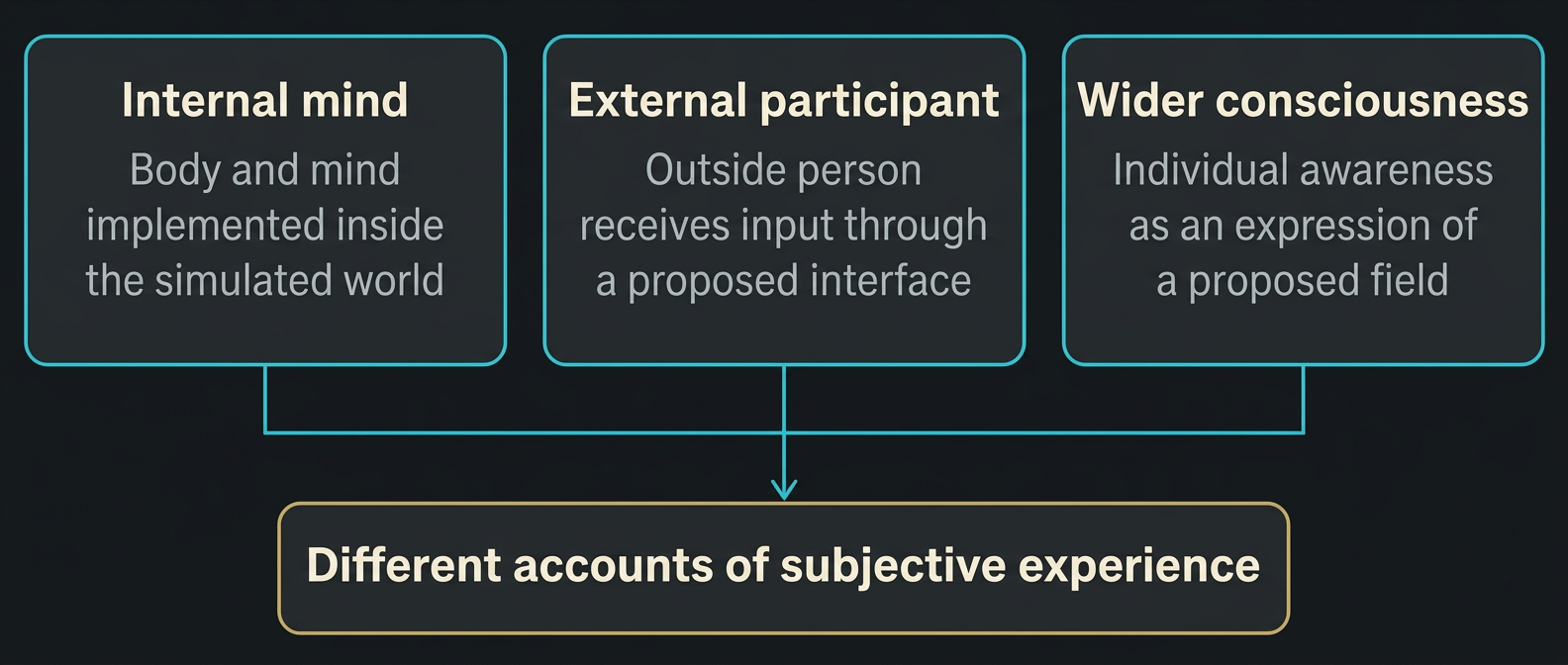
Figure 9 Three hypothetical accounts of a participant. An external body or consciousness is an added premise in the second and third accounts. None is established as a description of us.

A mind implemented inside the world

In the first account, the person's body, memory and mental processes belong to the simulation. There is no separate player required outside it. If the relevant processes supported consciousness, experience would occur as part of the implementation. A physical link resembling a SIM card would be unnecessary: the dependence is between the implemented process and the system implementing it.

A person receiving an artificial environment

In the second account, an external biological person receives sensory input from a virtual world. This resembles the familiar virtual reality analogy, extended far beyond present capabilities. The account requires an interface and a way to coordinate inputs, actions and bodily experience. It also introduces an outside life that the first account does not contain.

Consciousness as a wider field

A third, metaphysical account treats individual minds as local expressions of a more fundamental consciousness. That may be meaningful as a philosophical or spiritual position, but it does not follow from a computer simulation. Calling the proposed field a server leaves unanswered how it produces individual experiences or interacts with physical processes.

The question behind my connection metaphor is therefore not simply whether a person is linked to something larger, but what kind of person and connection the model assumes. An internal mind would need an intention response rule; an external participant would need an interface; a consciousness first account would need its own interaction theory. These are alternative ways to examine my proposed link, not discoveries about us.

CHAPTER 14 / 30 · 2 MIN READ

Why an outer civilisation might create worlds

If a civilisation could produce conscious worlds, what might motivate it? Considering possible purposes helps explain why a simulation might be built, but purpose is not something we can read directly from the idea of simulation. A world could be an experiment, an artwork, a training environment or an unintended consequence of another project. It might also have no continuing operator once started.

Exploration and historical inquiry

One imagined use is to explore how civilisations develop under different conditions. Another is to investigate possible histories. Neither requires every individual life to have a personalised lesson or a predetermined outcome. A model could be valuable to its makers because of broad patterns rather than because it guides each inhabitant toward a particular goal. Bostrom's discussion of ancestor simulations supplies a philosophical context for this branch of the idea. [9]

Learning and participation

An interactive environment could instead be designed for participants to learn. Within that fictional design, feedback might depend on their choices. It is possible to imagine rules that reward cooperation or help participants recognise consequences. It is equally possible to imagine a world that does none of those things. The simulation premise alone does not identify benevolent intent, educational purpose or an obligation to grant wishes.

If someone interprets a difficult experience as personally meaningful, that interpretation can be part of their own reflection. It does not establish that the experience was deliberately assigned by an outer system. In particular, suffering should not be explained away as a lesson people selected, earned or needed. The framework cannot infer hidden intentions from the mere existence of hardship.

Autonomy and intervention

A designer might choose stable rules precisely so that inhabitants can learn and act independently. Another imagined design might allow interventions. These choices create different worlds and different expectations. An intervention that changes an event would also need to fit, or alter, the surrounding chain of causes and records. A responsive world would still need a consistent account of what happens when participants want incompatible things.

Possible purposes help develop the world building part of my interpretation, but they do not establish a purpose for our lives. The creator cycle can be imagined without assuming personalised lessons or messages. If manifestation were included in such a world, it would need to be a specified feature of the design rather than something inferred merely from the existence of creators.

CHAPTER 15 / 30 · 2 MIN READ

Quantum physics and the simulation analogy

Quantum physics attracts attention in this discussion because it challenges everyday expectations about matter and measurement. That makes it fertile ground for analogy. It also makes it easy to attach claims to the word quantum that the experiments themselves do not establish.

Measurement is a physical interaction

In a double slit experiment, an interference pattern can develop when the alternatives remain coherent. Obtaining information about which path was taken can remove that interference. A NIST account describes the relationship between information gained by a measuring apparatus and measurement induced decoherence. This is a physical description of the measurement process; it does not require a person to consciously look at a result. [11]

It is tempting to compare this with a game engine displaying something when a player looks at it. That is a metaphor, not an inference from the experiment. The observation that a physical interaction changes a system does not establish that the system waited for a human mind before existing.

Entanglement is not a universal messaging system

Entanglement involves joint quantum states with correlations that challenge classical expectations. The 2022 Nobel Prize in Physics recognised experiments with entangled photons and the development of quantum information science. Those results concern carefully prepared and measured physical systems; they do not establish a network through which personal wishes command external events. [12]

IdeaWhat can reasonably be saidWhat does not follow
Quantum measurementMeasurement affects the physical description and observed statistics.Conscious attention creates whatever outcome we want.
EntanglementSome quantum correlations exceed classical limits.Thoughts communicate instructions to a cosmic server.
Mathematical lawsPhysics describes regularities mathematically.Equations prove the presence of computer code.
Limited knowledgeSome questions about reality remain unresolved.A specific simulation explanation is therefore correct.

Keeping the imaginative value

Quantum theory can encourage humility about what the world is like beyond familiar experience. It reminds us that an intuitive picture is not always an adequate physical model. The same humility should apply to the simulation story. An unfamiliar reality might be computational, or it might differ from familiar experience in ways that have nothing to do with software.

Quantum physics belongs in this discussion because it formed part of my initial intuition about how unfamiliar reality might be. Its contribution here is a question about the limits of everyday analogies, not evidence for my whole framework. It does not establish that biological complexity implies manufacture or that intention can communicate with a simulator. Those connections retain their own evidential requirements.

CHAPTER 16 / 30 · 2 MIN READ

Superintelligence and the creator cycle

In my interpretation, the important moment is when a creation becomes capable of creating something beyond itself. Superintelligence gives that possibility a more specific form. I am asking whether humanity could develop intelligence that understands biology, designs living systems and builds simulated environments far beyond our present abilities. If so, it becomes easier to imagine a similar transition elsewhere in a hypothetical chain of creators.

What superintelligence means

AI is the broad category. Superintelligence refers to a proposed level of intelligence substantially beyond human capabilities across a wide range of important cognitive tasks. It is not simply a replacement name for all AI. OpenAI discussed systems dramatically more capable than artificial general intelligence in its 2023 essay on superintelligence governance. The terminology therefore predates the latest wave of public discussion. [16]

From better design to further creators

As an extension of my starting idea, imagine an advanced intelligence helping design biological components, test virtual environments and coordinate the construction of new beings. Its creations might later acquire similar capabilities. This would extend the flesh and bone robot scenario into a repeating process of invention. However, being excellent at designing something does not guarantee access to materials, energy, experiments or manufacturing. A successful design also does not establish consciousness in the resulting system.

Intelligence and computing hardware are different questions

Superintelligence describes capability; quantum computing describes a way of processing information. One does not automatically imply the other. A hypothetical superintelligence could use classical computers, quantum processors or a combination. Quantum hardware does not become conscious merely because it uses qubits, and calling a system intelligent does not identify its physical substrate.

The connection back to my interpretation

The question I want to preserve is whether our emerging technologies could resemble early steps in a process that hypothetical creators already completed. Superintelligence strengthens the imaginative creator cycle scenario by supplying a possible designer of further beings and worlds. It does not establish that such a designer made humanity. That would require evidence about our origins beyond the capabilities of systems we build.

CHAPTER 17 / 30 · 2 MIN READ

Quantum computing is already here

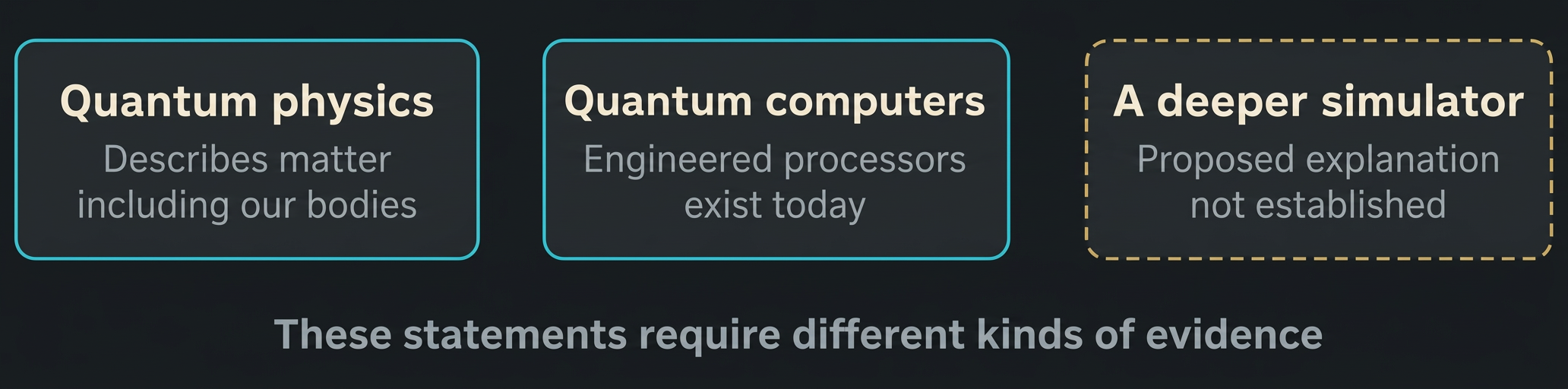
My intuition is that we may be discovering capabilities already embedded in the reality we inhabit. There are two separate claims here: quantum computers exist, and humans or their world might be implemented by a deeper quantum computer. The first is a technological fact. The second is the speculative extension I am exploring.

Existing machines and developing capabilities

Quantum computing is already available as real hardware. IBM offers access to quantum computers through its Quantum Platform; this is not merely a promise that machines might someday exist. [17] Quantum processors use controlled quantum states and operations to perform computations. Their usefulness depends on the task, algorithm and hardware; they are not automatically faster at everything or a replacement for every classical computer. [18]

Figure 10 Three distinct claims. Existing quantum hardware does not establish that people or the universe run on a hidden quantum computer.

What it could mean to operate on quantum physics

Our bodies consist of matter whose molecular behaviour is governed by quantum physics. That differs from demonstrating that the brain performs its cognitive work as a programmable quantum computer. It also differs from establishing an external machine that simulates our world. A quantum description of matter, biological information processing and an engineered quantum simulation are different claims.

Connecting the idea to manifestation

Even if a hypothetical simulator used quantum hardware, a separate mechanism would still be needed for intention to influence events through it. Someone would need to explain what reads the intention, what changes and how the effect could be tested. Quantum uncertainty or entanglement alone does not supply that mechanism.

My connection is therefore a question: could the quantum tools we are learning to build resemble part of the machinery of a deeper reality? That question belongs alongside biological technology, superintelligence and nested creators in my framework. Actual quantum computers make the technology concrete; they do not prove the proposed explanation of human origins or manifestation.

CHAPTER 18 / 30 · 2 MIN READ

Living code interacting with living code

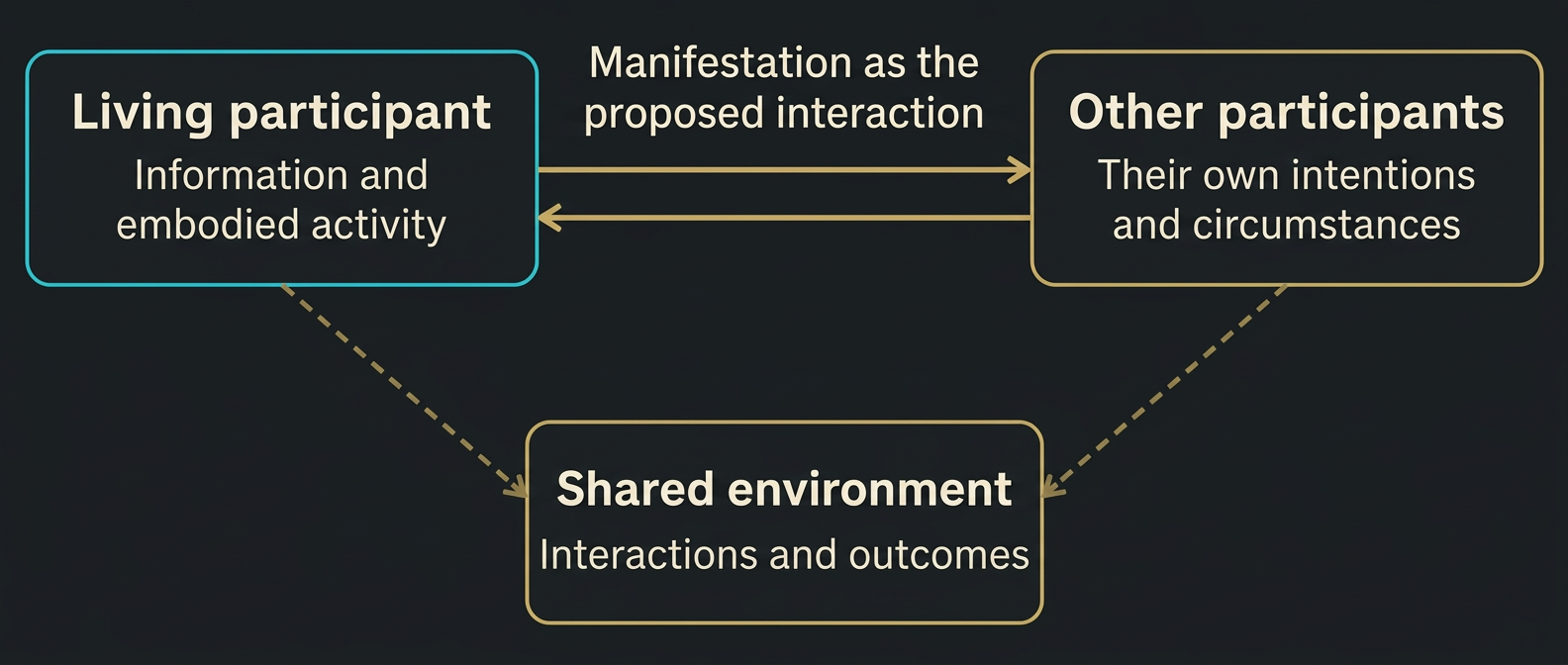
The phrase living code states the central image of my interpretation. A person is imagined as an embodied information system whose thoughts, perceptions and actions are states and processes within a wider reality. Other people are also participants. Manifestation is the name I give to the way those interactions produce encounters and outcomes within the proposed system.

Figure 11 The proposed living code relationship. Gold dashed links express the philosophical model, not detected channels or proven binary attraction.

Three meanings that must remain distinct

As an analogy, code means organised information and rules. As a claim about biology, it would require specifying physical structures that encode and process information. As a claim about a simulation, it would require evidence that those biological processes are implemented by a further computational system. The same word cannot establish all three claims merely by being used for each.

A concrete example of the proposed connection

Imagine two people whose interests and intentions bring them into the same conversation. In my framework, that meeting can be described as interacting living systems reaching a compatible state. An ordinary account might explain it through shared interests, social networks, location and timing. To claim a deeper computational attraction, the framework would need to predict something those ordinary factors do not already explain.

The meaning of nothing is coincidence

Within the model, this phrase asserts that events belong to a connected underlying process. Connection alone does not show that every event has a personal purpose, responds to a wish or carries a message. The claim remains a premise to examine. Its role here is to express my interpretation faithfully while keeping causal connection, intentional arrangement and personal meaning distinct.

CHAPTER 19 / 30 · 2 MIN READ

Thought intention and the law of attraction

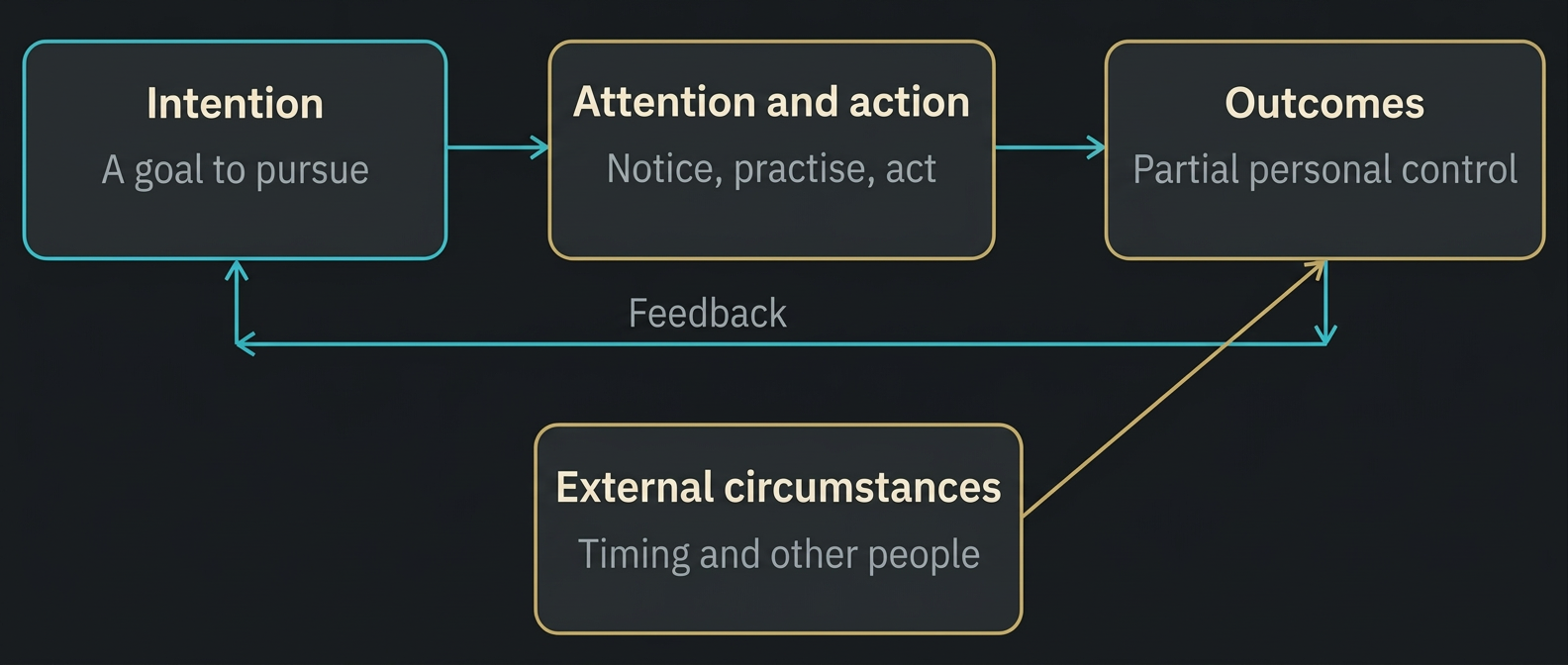
In my interpretation, manifestation describes living code interacting with living code. Thoughts, actions, encounters and responses belong to one proposed underlying system. This chapter separates the ordinary pathways through which people influence one another from the stronger claim that a shared computational structure explains attraction or apparently coincidental events.

Figure 12 An ordinary pathway from intention to outcomes. Feedback changes future behaviour, while circumstances and other people also affect the result.

A practical example

Imagine deciding to start a business. The idea may lead you to notice relevant problems, speak to potential customers, practise a pitch and make repeated attempts. Those actions change your exposure to opportunities. A meeting that feels remarkably well timed may have become more likely because you began entering the places and conversations where it could happen.

This does not make thought irrelevant. It gives thought a concrete role. An intention can organise effort, and a plan can turn that intention into something observable. Research on mental contrasting and implementation intentions examines how people connect a desired future with obstacles and specific actions. That is a behavioural mechanism, rather than evidence that visualisation broadcasts instructions to the universe. [13]

What the computer metaphor would need to establish

For a thought to act as a command to an outer system, the proposal would need to identify an interface, a way of encoding the command and a repeatable relationship between the command and an outcome. It would also need to distinguish that relationship from ordinary action, chance, selective memory and influence from other people. Naming the hypothetical interface quantum or nano does not supply those missing steps.

Within my framework, manifestation and simulation connect through proposed shared rules of interaction. This is a premise, not a consequence established by simulation alone. Those rules need not privilege individual wishes.

Interaction and agency

My central image is living code interacting with living code. Ordinary effects through communication and action differ from a proposed direct channel between private intention and events. Other people and external circumstances also shape outcomes.

CHAPTER 20 / 30 · 2 MIN READ

When intention is treated as an instruction

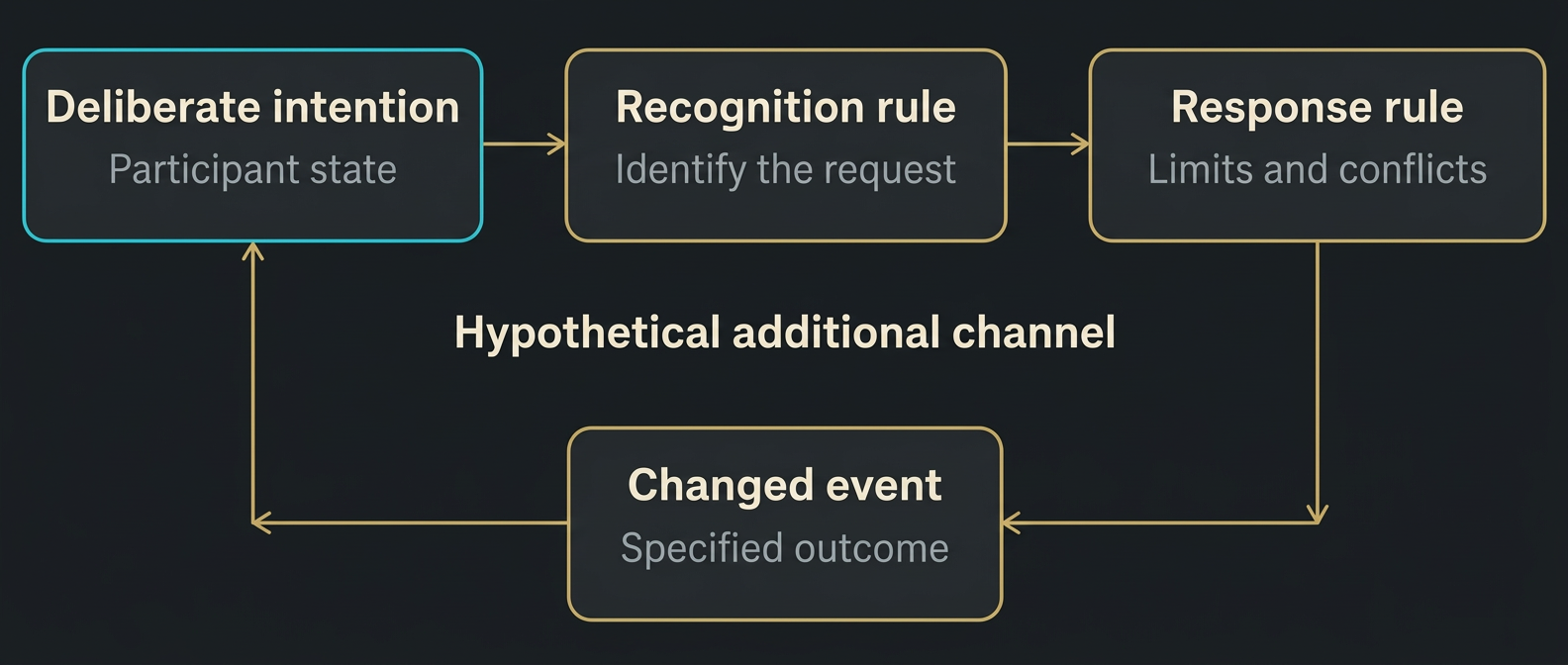
The core living code proposal does not require a person to send a wish to an external controller. It describes interaction within a shared system. This chapter examines a stronger, optional version: a system that recognises deliberate intention and responds to it specifically. That version needs additional rules and should not be confused with the basic claim that people affect one another.

Figure 13 The additional machinery required by an intention responsive simulation. Every gold dashed connection is hypothetical. Simulation alone does not supply this pathway.

What counts as an input

A simulator could represent an agent's internal state without treating that state as a request. For intention to function as a command, the model would need a rule for identifying intentions and distinguishing them from passing images, unwanted thoughts, dreams and contradictory desires. Merely recording a state is different from interpreting and acting on it. This is the missing step in the analogy between thinking and sending instructions to a computer.

What counts as a response

The response might be limited to information presented to the participant, opportunities within the environment or a change in how uncertain events are generated. These are different proposed mechanisms. A model should specify which it means and what it predicts. If it can reinterpret any success, failure or delay as the intended response, it offers no clear way to distinguish its operation from ordinary events.

Why the connection remains conditional

This command and response version is one possible extension of my living code interpretation. It is not required simply to describe interacting participants. If the claim is that private intention changes distant events without ordinary communication or action, however, a mechanism and distinguishable evidence would be needed.

CHAPTER 21 / 30 · 2 MIN READ

Three meanings of changing your reality

The phrase change your reality can refer to a changed experience, a changed course of action or a changed external event without ordinary mediation. These meanings can feel similar from the inside while making very different claims about what caused the result.

Changing experience and interpretation

An intention can change what a person attends to and how they interpret an event. A conversation that once seemed irrelevant may become useful after a new goal gives it context. The surroundings need not have been rearranged for the experience of them to change. In the operating system analogy, this is a change in how information is selected and used. It does not imply that perception creates external objects.

Changing behaviour and opportunity

A goal can also change what someone does. A person hoping to launch a venture may ask better questions, practise explaining the offer and approach more suitable partners. These actions can change the number and quality of opportunities encountered. The causal pathway includes other people, institutions and resources. Its effects are real even when they are uncertain, delayed or smaller than hoped.

Research on mental contrasting with implementation intentions concerns this connection between goals, obstacles and action. In one randomised study of resident physicians, a WOOP exercise was compared with goal setting for study behaviour. That is evidence relevant to self regulation in a particular context, not evidence that thoughts instruct a cosmic system. [14] The practical lesson is to connect an imagined outcome to an observable next step, while checking what actually happens.

Changing events through an additional channel

The stronger manifestation claim says that intention influences external events beyond changes in attention, action or communication. The proposed simulation interface belongs here. A world designed with such a channel is imaginable, but identifying that channel in our world would require evidence that rules out the ordinary pathways. A desired outcome following a wish is not sufficient on its own to establish the route between them.

Consider receiving a helpful introduction. Perhaps a friend remembered a conversation, someone saw a public post or an ordinary coincidence brought the meeting about. The introduction may still be valuable and personally meaningful. The additional claim that an outer system arranged it must do more explanatory work than simply repeat that it felt significant.

The third meaning is the distinctive question I originally wanted to connect to simulation: could thought affect the implementing system itself? The first two meanings explain how intention can matter without that connection. Keeping all three visible lets the article develop my larger possibility while recognising when an outcome is adequately explained by attention, behaviour and ordinary social causes.

CHAPTER 22 / 30 · 3 MIN READ

What an intention responsive world would need to resolve

Developing the manifestation hypothesis in detail exposes useful design questions. These questions do not refute every imaginable responsive world. They show how much must be specified before the proposal becomes more than an appealing analogy.

Conflicting intentions

Suppose two people want the same exclusive opportunity. A shared world cannot give both the identical outcome under identical conditions. A proposed system would need rules for resolving conflict, limiting requests or producing alternatives. Those rules might depend on fairness, resources or some other criterion, but none can be inferred from the desire itself. Describing unsuccessful requests as misalignment merely renames the outcome unless alignment can be defined independently.

Stable laws and unusual outcomes

A responsive model could hypothetically operate within ordinary looking events rather than suspending physical laws. For example, it might change which opportunities appear in a fictional environment. But remaining compatible with ordinary events is not the same as being supported by them. If the proposed responses are indistinguishable from chance and ordinary social causes, their existence cannot be established from the outcomes alone.

Private thought and deliberate choice

People can imagine outcomes they do not want, feel conflicting emotions or have unwanted thoughts. A model that treats every mental event as an instruction would have serious conceptual problems. A more coherent hypothetical design would distinguish deliberate requests from incidental mental activity. There is no established basis for believing that intrusive or fearful thoughts cause feared events, or that someone must keep their mind perfectly positive to remain safe.

Shared history and other people

A change benefiting one participant affects a wider network. The imagined system would have to preserve or account for other people's observations, records and choices. One person's preferred future might restrict another's autonomy. The idea of individual manifestation therefore becomes more demanding when applied to a shared world rather than a private dream or a single player story.

Permission is a separate premise

Being represented inside a system is different from controlling it. A weather model can represent a storm without giving the storm the ability to alter the program. Similarly, an intelligent inhabitant of a simulated world would not automatically gain access to its underlying rules by understanding the possibility of simulation. The proposed connection would have to be a real feature of the imagined design, with specified limits, rather than a power that follows from awareness alone.

These design questions make the connection in my interpretation more concrete. A biological participant, an outer implementation and an intention channel would need to function together in a shared world with conflicting goals. My original idea supplies the proposed relationship; these added constraints examine what it would take to make that relationship coherent. They do not demonstrate that the relationship exists.

CHAPTER 23 / 30 · 2 MIN READ

Coincidence synchronicity and personal meaning

Within my interpretation, the phrase nothing is coincidence expresses the premise that apparently separate encounters belong to an underlying pattern of interaction. I regard manifestation as the experiential name for that pattern. This is a philosophical commitment in the model. An encounter that feels meaningful does not by itself demonstrate hidden coordination, a personal message or a computational origin.

Meaning and mechanism answer different questions

Asking what an event means to you concerns interpretation, values and the way you understand your life. Asking what caused the event concerns the processes that produced it. An encounter may inspire a decision even when it arose through ordinary circumstances. Preserving that personal meaning does not require asserting that the encounter was programmed for you.

Within the speculative framework, a participant might interpret such events as feedback from a responsive world. That interpretation is possible as a narrative, but it competes with explanations involving attention, shared routines, social connections and coincidence. The model must account for all relevant events, including occasions when the thought was not followed by a call or when a hoped for opportunity never appeared.

The importance of the denominator

Imagine recording every person you think about for a month, together with every subsequent message. A few matches may stand out, but assessing their significance requires knowing how many thoughts, people, messages and time windows were involved. A match within an hour is a different prediction from a match at any time during a year. Expanding the window after seeing the result makes success easier to find.

The same issue applies to repeated symbols or numbers. Before treating a pattern as evidence, one would need a defined pattern, a defined observation period and an account of how often comparable patterns could occur. A compelling story selected after the fact is different from a prediction specified beforehand. Ordinary coincidences and perceived patterns do not demonstrate that an external intelligence is communicating with an individual.

Keeping curiosity without surrendering judgment

A useful response to an unusual encounter is to note it, consider ordinary explanations and decide whether it suggests a sensible action. That action can be evaluated on its own merits. The framework does not require ignoring evidence, abandoning commitments or interpreting every difficulty as a signal. Curiosity is compatible with allowing some events to remain unexplained.

The distinction matters for my framework: an event can have causes without having been arranged for me. Even a deterministic system can produce independent processes whose intersection is reasonably called coincidence. To claim that living code explains a particular encounter, the model must predict more than the broad statement that events occur within the same world.

CHAPTER 24 / 30 · 2 MIN READ

How the proposed connection could be investigated

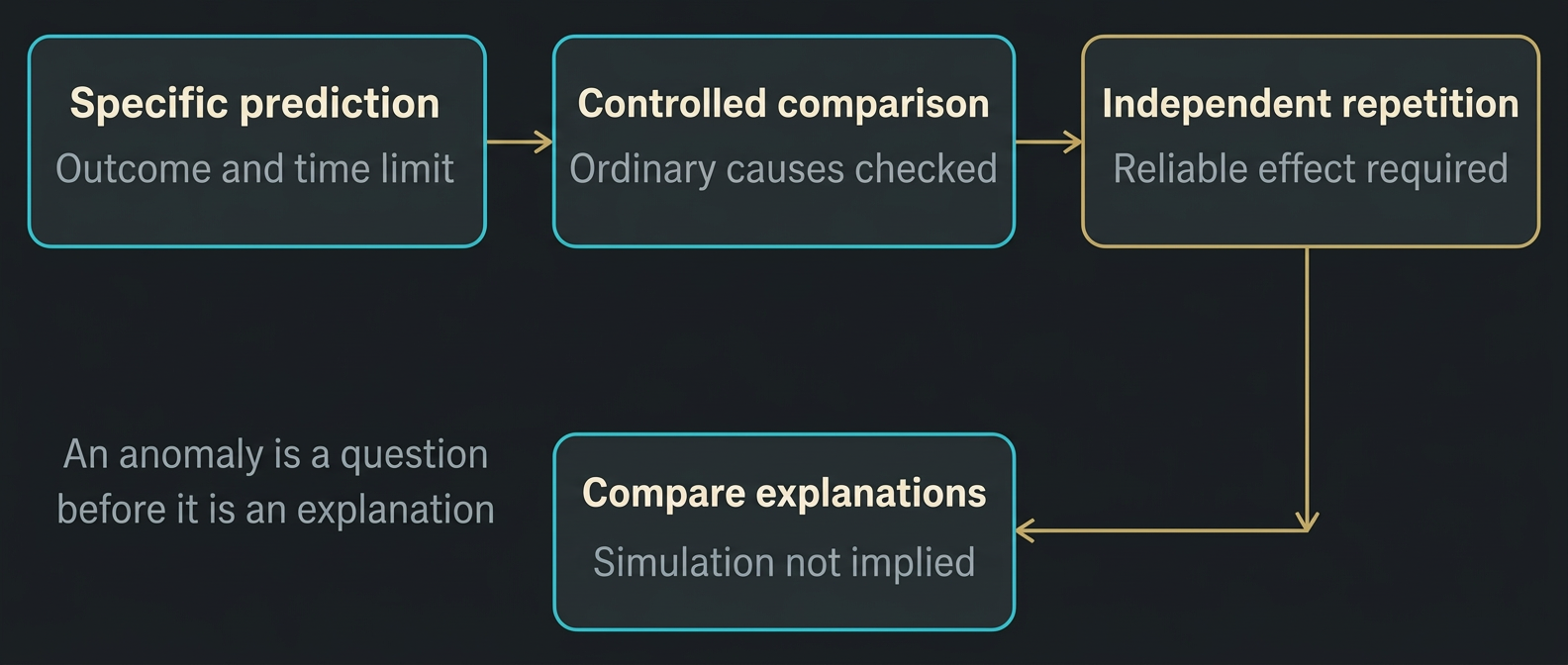
A useful investigation must distinguish two questions: does intention predict an outcome beyond ordinary pathways, and would such an effect establish simulation? Even a reliable unexplained association would not automatically identify an external computer. It would first establish something narrower that requires explanation.

Figure 14 A route from a specific claim to evidence. A repeatable effect would still require competing explanations to be compared before inferring a simulator.

State the prediction before the outcome

A testable version would specify the intended outcome, the time window, what counts as a success and the comparison condition. It would also specify how ordinary communication or action could affect the outcome. A claim about getting a new client is difficult to isolate because effort, reputation and other people's decisions all matter. A controlled task can reduce some of those complications, although its relevance to broader life claims must still be justified.

Keep ordinary explanations in the design

An adequate study would need sufficient observations, appropriate randomisation, protection against information leakage and analysis rules fixed in advance. Blinding would matter wherever expectations could affect measurement or scoring. Both successes and failures should be retained. These safeguards address alternative explanations; they are not a promise that a manifestation effect exists or that a simple personal experiment can settle the question.

Replication before a cosmic interpretation

A result should survive independent repetition and checks for errors before supporting a new causal claim. If it did, the next task would be to compare explanations and identify a mechanism. An unexplained effect could reflect an ordinary confound or an unfamiliar physical process rather than simulation. The leap to an outer intelligence would require additional evidence that specifically favours that explanation.

The investigation circles back to my original connection: does intention influence a wider system, or does it change how we participate through ordinary action? A personal record can clarify goals and outcomes, but it cannot by itself establish a cosmic channel. Even a reliable additional effect would need explanation before it supported the complete biological creator and simulation framework.

CHAPTER 25 / 30 · 3 MIN READ

Using intention while keeping agency and perspective

There is a practical version of manifestation that remains useful whether or not any simulation hypothesis is true. It begins with a desired direction, translates it into behaviour and uses feedback to revise the plan. The operating system metaphor can make this memorable: clarify the objective, identify the available inputs and examine the results. It remains an analogy for self regulation rather than a method for accessing hidden code.

Start with an outcome you can describe

Choose a goal specific enough to guide a decision. Instead of wishing vaguely for success, describe the kind of project, relationship or skill you want to develop. Then separate the part you control from the part that depends on others. You may control preparing a proposal and asking for a meeting. You cannot control another person's agreement, timing or priorities.

Pair imagination with an obstacle and an action

Picture the desired future, then identify a realistic obstacle in the present. Convert that obstacle into an if then plan. If uncertainty makes you delay an introduction, then draft a short message and set a time to send it. This sequence resembles the practical structure used in mental contrasting with implementation intentions. Its purpose is to support action, not to guarantee the outcome. [13, 14]

Review what changed

After an agreed period, ask what you actually did, what opportunities arose and what feedback suggests. Include disappointments rather than removing them from the story. A plan can be revised because it was poorly matched to circumstances, because priorities changed or because success depended on conditions you could not control. None of those explanations requires a failure of belief.

The simulation metaphor can remain an imaginative lens during this practice: an intention changes your participation in the world. That statement is meaningful through attention and behaviour. A further claim that the world itself responds through a hidden channel remains separate and should not replace ordinary evidence when making consequential choices.

A boundary that protects the idea from misuse

Other people are not obstacles generated solely for your development. Their experiences and choices deserve respect regardless of anyone's metaphysical beliefs. Illness, poverty, loss and mistreatment should not be attributed to victims having the wrong thoughts. A compassionate framework recognises constraints, chance and shared responsibility rather than treating every outcome as an individual's mental creation.

The practical connection to my interpretation is participation: whatever the ultimate origin of our bodies and world, we experience intentions, make choices and encounter consequences. The larger simulation possibility can remain an imaginative question while goals are translated into observable action. Practical benefits from that process would support the practice; they would not independently prove my proposed origin story or manifestation channel.

CHAPTER 26 / 30 · 2 MIN READ

How to evaluate the larger idea

A compelling explanation should make room for the question that a thoughtful listener will eventually ask: what would count as evidence? The aim is not to remove imagination from the discussion. It is to distinguish a useful possibility from a claim that has earned our confidence.

Separate compatibility from support

Many observations may be compatible with a simulation. Mathematical regularities, information processing and complex life could all appear in a hypothetical computed world. They can also appear in an account that makes no claim about an external computer. An observation supports one explanation over another only when there is a reason to expect it more strongly under the first explanation.

A more testable proposal would specify some measurable difference between its version of a simulation and an alternative physical account. It would explain in advance what should be observed, use procedures that others can repeat and survive attempts to identify ordinary explanations. An unexpected finding would first be evidence that something needs explanation; it would not immediately identify a programmer.

Why apparent glitches are weak evidence

A coincidence, a memory mismatch or a strange perception can be striking without revealing the architecture of the universe. Treating every anomaly as confirmation makes the proposal harder to assess because any possible outcome can be absorbed into the same story. A useful question is whether the event would still seem persuasive if we had not already been thinking about simulation.

Questions that sharpen the discussion

Does the proposal assume biological engineering, digital simulation or both? What makes its inhabitants conscious? Why would creators build such worlds? What resources would support them? What evidence could change our minds? These questions identify the assumptions doing the work and prevent a vivid analogy from quietly becoming a certainty.

The ethical implications remain concrete

If an artificial being could suffer, learn and form interests, its origin would not make those interests meaningless. Within the hypothetical world, choices and relationships would still have consequences for those who experienced them. Describing a person as implemented by computation would not justify dismissing them as disposable.

The larger idea returns to the same connected questions: are living beings comparable to advanced technology, could created beings become creators, could their worlds be nested, and could intention interact with the implementation? Evaluating those questions separately strengthens the account of their relationship. Whatever the answers, the experiences and interests of people within the world remain consequential.

CHAPTER 27 / 30 · 2 MIN READ

Born Coded in one narrative

What if we are the technology? When I look at a robot, I see a frame, motors, sensors and a processor. When I look at a person, I see something that grows, learns, repairs some of its own damage and supports an inner life. Born Coded begins with my question about whether our idea of technology is limited by the materials and machines we happen to recognise today.

A body is made from organised matter. Its cells use molecular machinery, exchange information and maintain conditions in which larger systems can function. That makes biological life an extraordinary engineering comparison. It does not establish an engineer behind our origins. Evolution remains the scientific account of how our biological features developed. The comparison opens a possibility rather than closing the question.

Imagine a future civilisation capable of building increasingly sophisticated biological systems. Its machines might use living muscle and sensory tissue. They might grow into their form rather than arrive as finished products. If such systems could become conscious, the distinction between a machine and a living being would become much less useful than questions about their experiences, needs and capacities.

Now imagine that these beings become inventors. They study their environment, cooperate and develop technologies of their own. Eventually they create new beings. The process could repeat: creators produce beings who become creators. That is the biological branch of the idea. It suggests a possible lineage, although our ability to imagine that lineage does not show that we belong to one.

The simulation branch goes further. Instead of engineering only a body, suppose a civilisation implements an entire experienced environment. Its inhabitants might be conscious processes inside the computation, rather than people wearing headsets outside it. Their bodies, memories and scientific instruments could all belong to the same world. From their perspective, that world would be the place in which life happens.

If they then build their own conscious simulations, a world could contain another world. More layers might follow, subject to limits of resources, knowledge and choice. An outer implementation would explain how an inner world is produced, while leaving the origin of the outer world unresolved. Simulation within simulation is therefore a possible structure, not a complete answer to why anything exists.

That brings me back to my central connection: humans as living technology within a shared system, capable of creating further beings and worlds. In my interpretation, manifestation names the interaction of those living systems. Superintelligence and quantum computing extend the questions about what creators could build. The framework links these ideas; evidence is still needed to establish that it describes our origins and experience.

CHAPTER 28 / 30 · 2 MIN READ

Manifestation within Born Coded

My proposal is that the apparent separation between a person, another person and their world conceals a deeper continuity. I picture each person as a living information system whose states and actions interact with the states and actions of others. What we call manifestation is, within this interpretation, the unfolding of those interactions. It is part of how the proposed system operates.

Walking microchips as the central image

The image of a walking microchip captures the contrast that first interested me: we recognise a machine when we see metal and circuits, yet a body performs extraordinary sensing, learning and coordination through living tissue. I use code to imagine the organisation behind those capabilities. Calling a human a microchip remains an analogy unless the model identifies an actual architecture, encoding and operations that can be measured. Molecular complexity alone does not identify a manufacturer.

What attraction between zeros and ones means here

In this framework, attraction between zeros and ones is shorthand for compatible information states interacting. It is not a literal physical force established between the symbols 0 and 1. To turn the image into an explanation, I would need to define what compatibility means, how information travels between people and which interaction rules produce an outcome. Otherwise the phrase redescribes an encounter without explaining it.

Connection does not mean personal control

A shared system contains other people with their own intentions, histories and constraints. My desire alone would not specify its next state. A failed goal, illness or painful event therefore cannot be taken as evidence that someone used the wrong thoughts or code. Ordinary choices, communication, chance and external circumstances remain necessary parts of any account of what happens.

How this returns to the creator cycle

Born Coded brings the creator cycle and the interaction of living systems into one interpretation. Future biological beings could, in the imagined scenario, create descendants of their own. Nested simulations supply a possible setting for further generations. Manifestation is my proposed description of interaction within that shared reality. The question returns to its starting point: what if we are the technology? It remains a philosophical inquiry whose claims must be assessed through evidence.

CHAPTER 29 / 30 · 2 MIN READ

How existing work relates to Born Coded

The questions explored here have precedents. Bostrom's simulation argument examines a conditional relationship between advanced civilisations, ancestor simulations and the number of simulated observers. It does not establish an intention responsive universe. Kipping's Bayesian discussion examines uncertainty in the argument rather than demonstrating that our world is implemented by an outer computer. [9, 10]

There is also a close informal precedent for the creator cycle theme. Steve Foley published The Recursive Creation Hypothesis on 16 March 2025, discussing intelligence creating intelligence and relating that pattern to simulation and self discovery. It is an independently published speculative essay, not experimental confirmation. Acknowledging it matters because neither the phrase nor the broad creator cycle concept should be presented here as uniquely new. [15]

The focus of this synthesis

This essay connects biological intelligence, future engineered beings, recursive creators and nested simulations with my interpretation of manifestation as living code interacting within a shared system. The synthesis begins with my supplied interpretation; its explanations and diagrams were developed with AI assistance. Related work is credited, and the combination is not presented as proof of a new law of physics.

The demanding step is moving from the useful language of information processing to a literal claim that people are computational units whose interactions explain manifestation. The framework must specify what code means, how systems interact and what observation would distinguish its account from ordinary biology, communication and probability. An intention reading simulator is a further variant, not the definition of the entire proposal.

How to describe it to another person

A concise description is: this is my philosophical framework connecting humans as living information systems, creations that become creators and worlds within worlds. Within it, manifestation describes living code interacting with other living code. The article develops this interpretation while separating its premises from established biology and physics.

That description invites discussion without demanding agreement. A listener can accept the biological analogy, remain uncertain about simulated consciousness and reject the manifestation extension without contradiction. Each part can be assessed separately. The framework becomes clearer when disagreement helps identify which assumption is doing the work.

Born Coded is the name for my interpretation of humans as living technology, capable of creating further beings and worlds, with manifestation understood as interaction within a shared system. Existing work supplies background and challenges. My authorship concerns this presentation and synthesis; it does not imply that every component originated with me or that the framework has been experimentally confirmed.

CHAPTER 30 / 30 · 2 MIN READ

Terms and distinctions

These terms describe different parts of the argument. Keeping them distinct makes it easier to explain the idea without accidentally claiming more than it contains.

TermMeaning in this document
NanometreOne billionth of a metre; a unit of size.
NanotechnologyThe understanding and control of matter at approximately 1 to 100 nanometres.
Molecular machineA molecular structure that performs organised physical or chemical work.
Biological engineeringThe deliberate modification or organisation of living systems for particular functions.
Artificial lifeA broad label that can include constructed biological systems and computational models; it does not automatically mean consciousness.
ConsciousnessSubjective experience, or there being something it is like to be a system.
SimulationA process that represents or models another system. Its contents are not automatically conscious.
SubstrateThe physical medium or system in which a process is implemented.
Nested simulationA simulated world containing a process that implements a further simulated world.
Base realityA proposed level that is not itself a simulation. The term does not establish that we can identify such a level.
RecursionA structure or process that repeats a similar operation within or upon itself.
AnalogyA comparison that helps understanding but does not, by itself, establish identical causes or properties.
Intention responsive modelA hypothetical world with an additional rule linking recognised intention to events.
ManifestationWithin this framework, living code interacting within a shared system; distinguished from ordinary goal pursuit and a proposed direct intention channel.
InterfaceA specified route of interaction between systems; no cosmic interface is assumed to have been detected.

The argument in one paragraph

My interpretation connects living bodies as advanced technology, creations becoming creators and worlds within worlds. Manifestation names the proposed interaction of living information systems. Biology supports information processing analogies; engineered origins, conscious simulations and binary attraction remain separate hypotheses requiring evidence.

ABOUT ME

Peter Karam

Born Coded began with my question: what if the technology we are trying to create resembles what we already are? I developed this philosophical thought experiment in October 2026.

AVAILABLE FOR SPEAKING

Keynotes · TED / TEDx · Panels

I’m open to keynote speeches, TED and TEDx talks, conference sessions, podcasts and panel discussions on humans as advanced biological machines, the simulation hypothesis and the future of created intelligence.

Speaking inquiry

Your details and message are stored privately for Peter’s correspondence.

STAY CONNECTED

The next chapter of Born Coded

CONTACT

Get in touch

Speaking invitations, conversations and questions for Peter Karam.

Your details and message are stored privately for Peter’s correspondence.